Beat Haldimann

Don't hesitate to ask for any additional information, Alex is ready to assist and guide you in your decision
DETAILS
Beat Haldimann is an exception among independent watchmakers. He rarely participates in exhibitions, and sometimes it seems that he does not want his watches or himself to be advertised as an independent watchmaker because he believes – and we think with good reason – that connoisseurs of high-end collectors' watches will seek him out themselves. He and his small team in the Swiss town of Thun are dedicated to traditional watchmaking. Beat Haldimann’s vocabulary includes the principles of movement design laid down in the 19th century by the German watchmaker and technical genius Moritz Grossmann, and adherence to the principles of the Nordic style, including the delicate tourbillon cages of another famous German watchmaker, Alfred Helwig. Haldimann’s villa in Thun, which is the company’s headquarters and production workshop, is completely free of CNC machines, without which we can hardly imagine the modern production of luxury and collector's watches. All metal parts, including movement parts and case parts, are made and machined by hand on watchmakers' lathes and other traditional equipment. There are only a few watchmakers in the world who are willing and able to work in this traditional way.
REASONS TO BUY
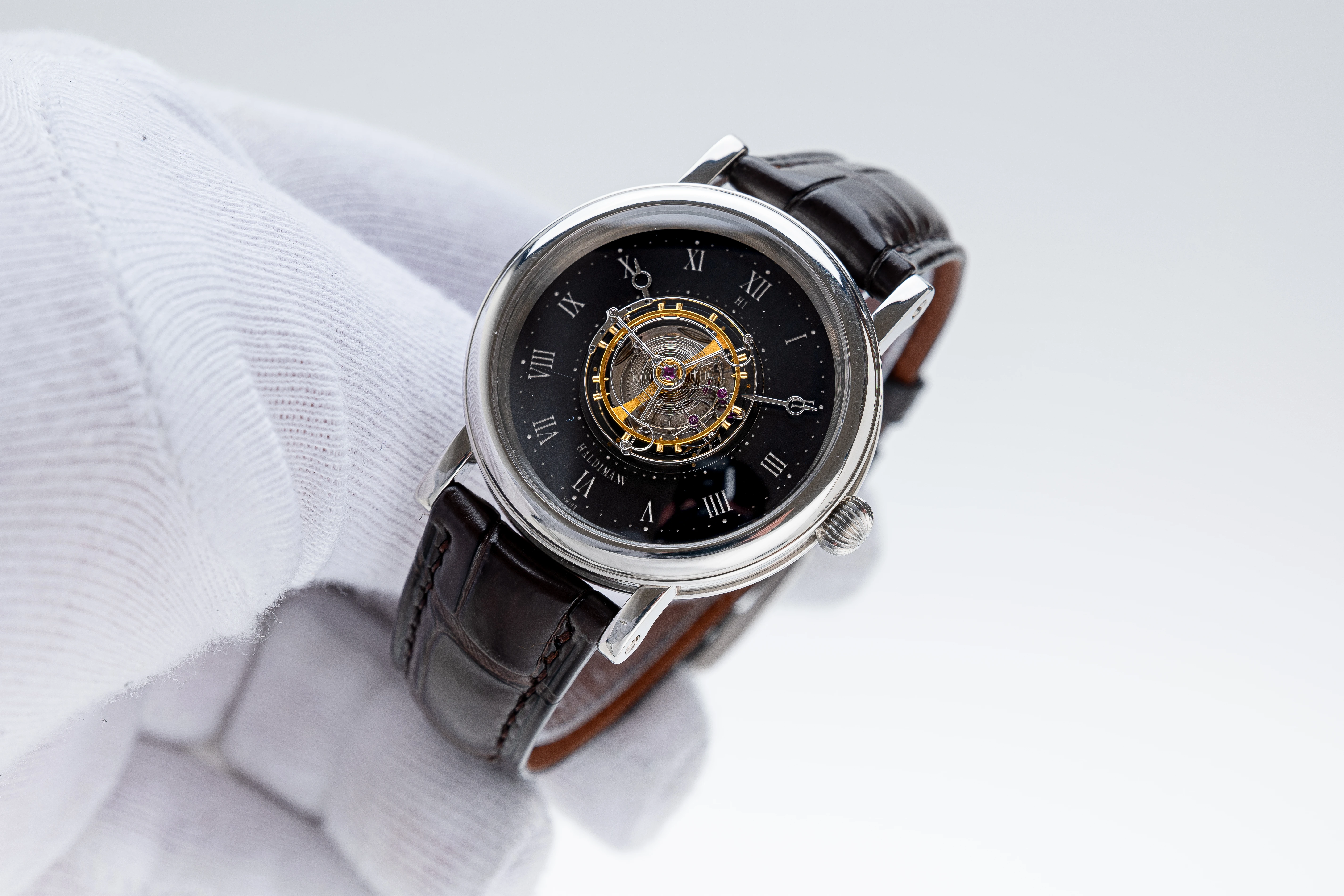
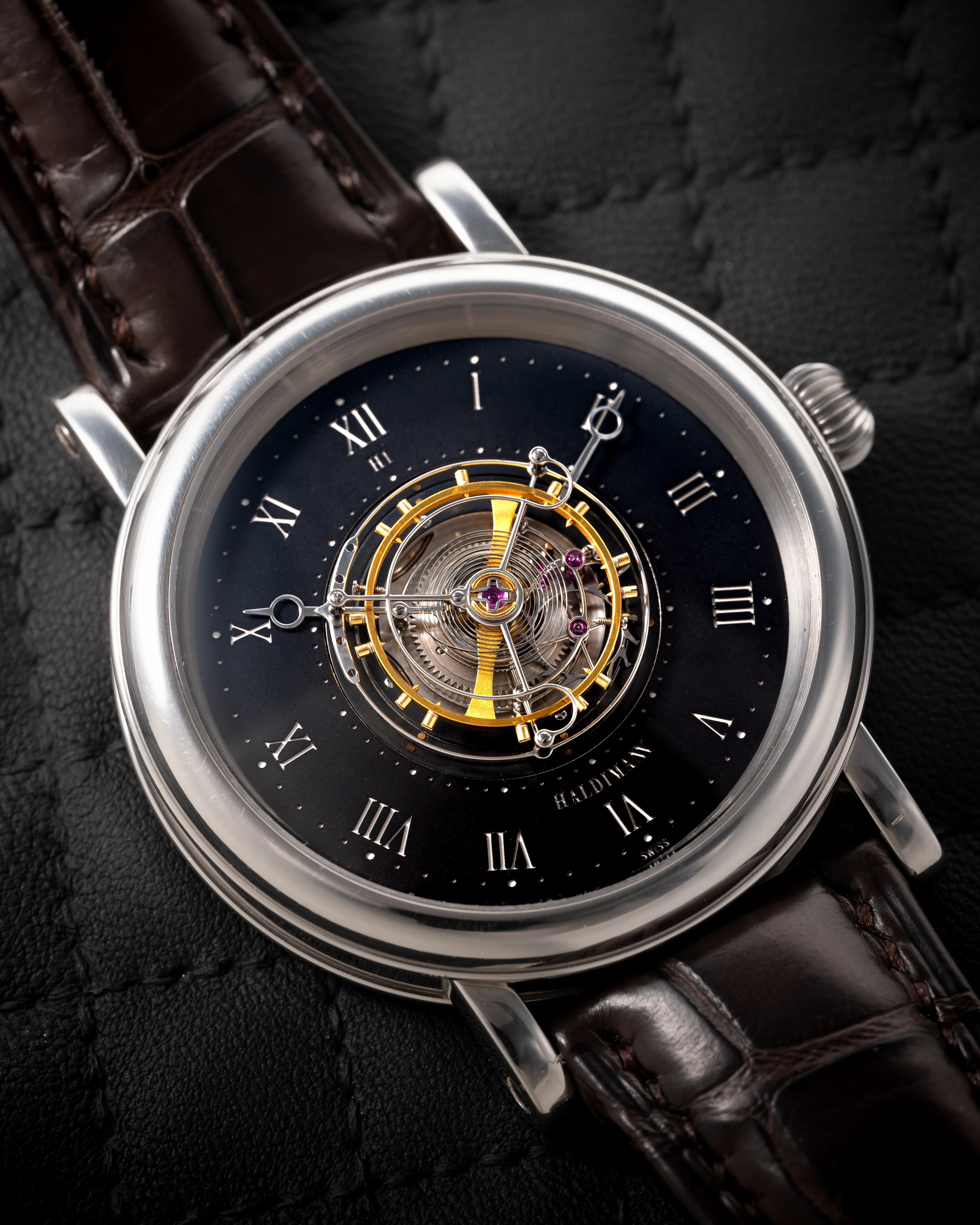
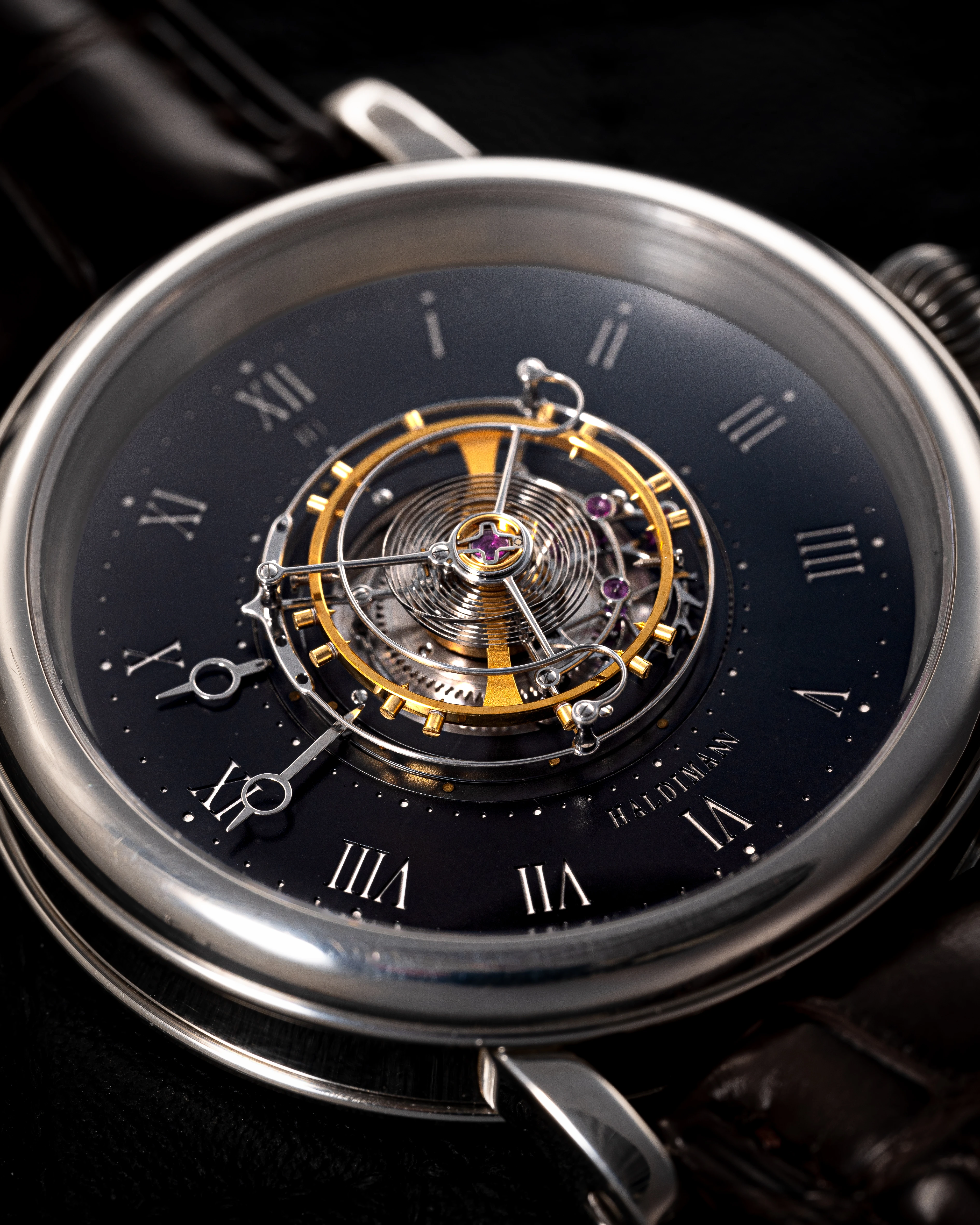
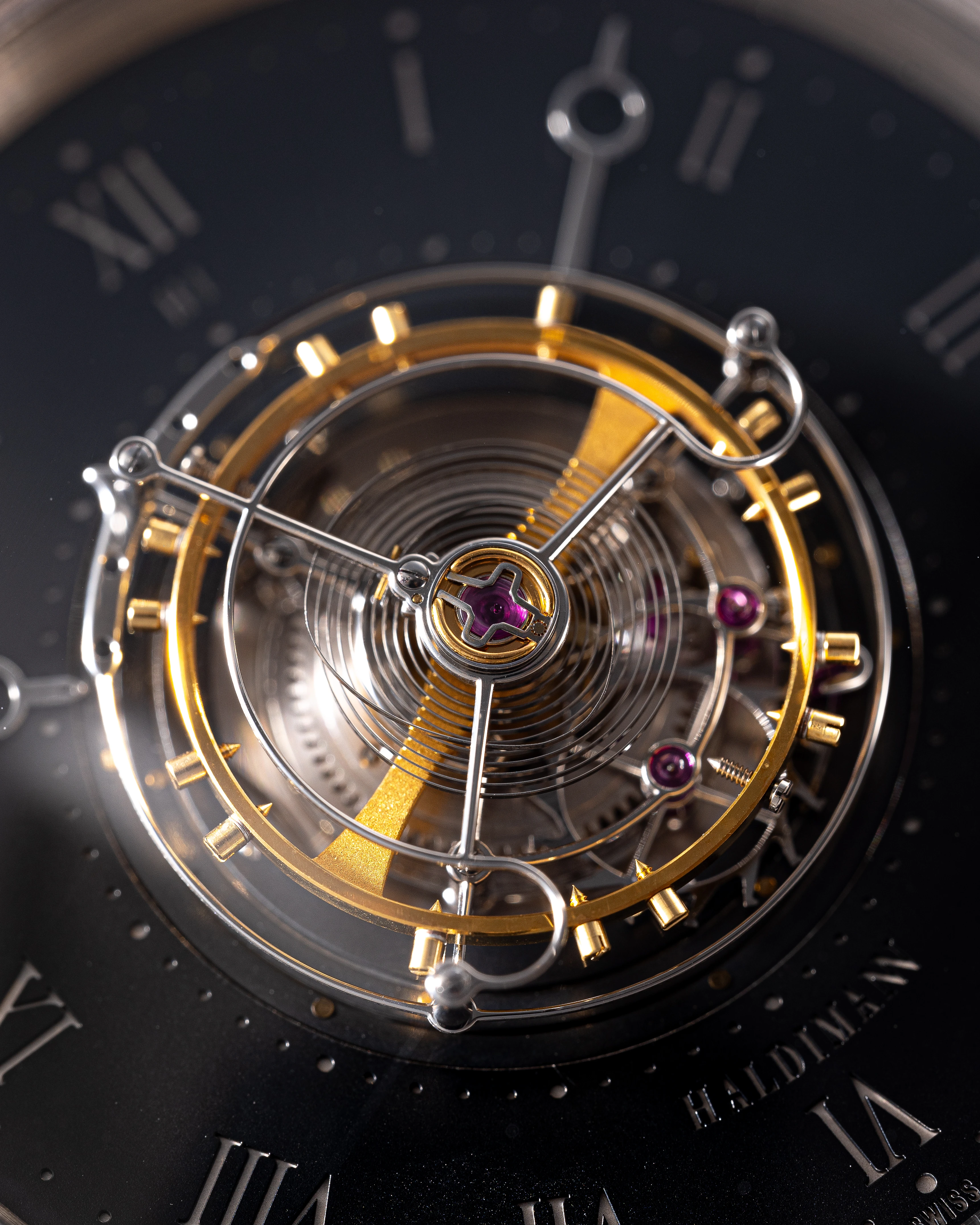
The Beat Haldimann H1 Flying Central Tourbillon in platinum with a black dial is certainly worthy of the collector's attention, as it is one of the rarest, most esthetically impressive and technically outstanding tourbillons produced by modern independent watchmakers. The value of this watch is enhanced by the fact that Beat Haldimann does not use computer-controlled technology in its production, but makes the watches exclusively by hand. This is why the sight of the central flying tourbillon H1, which rises above the dial, is a delight for the discerning connoisseur, as the artfully crafted and finished filigree tourbillon cage cannot be found in this size in any other wristwatch.
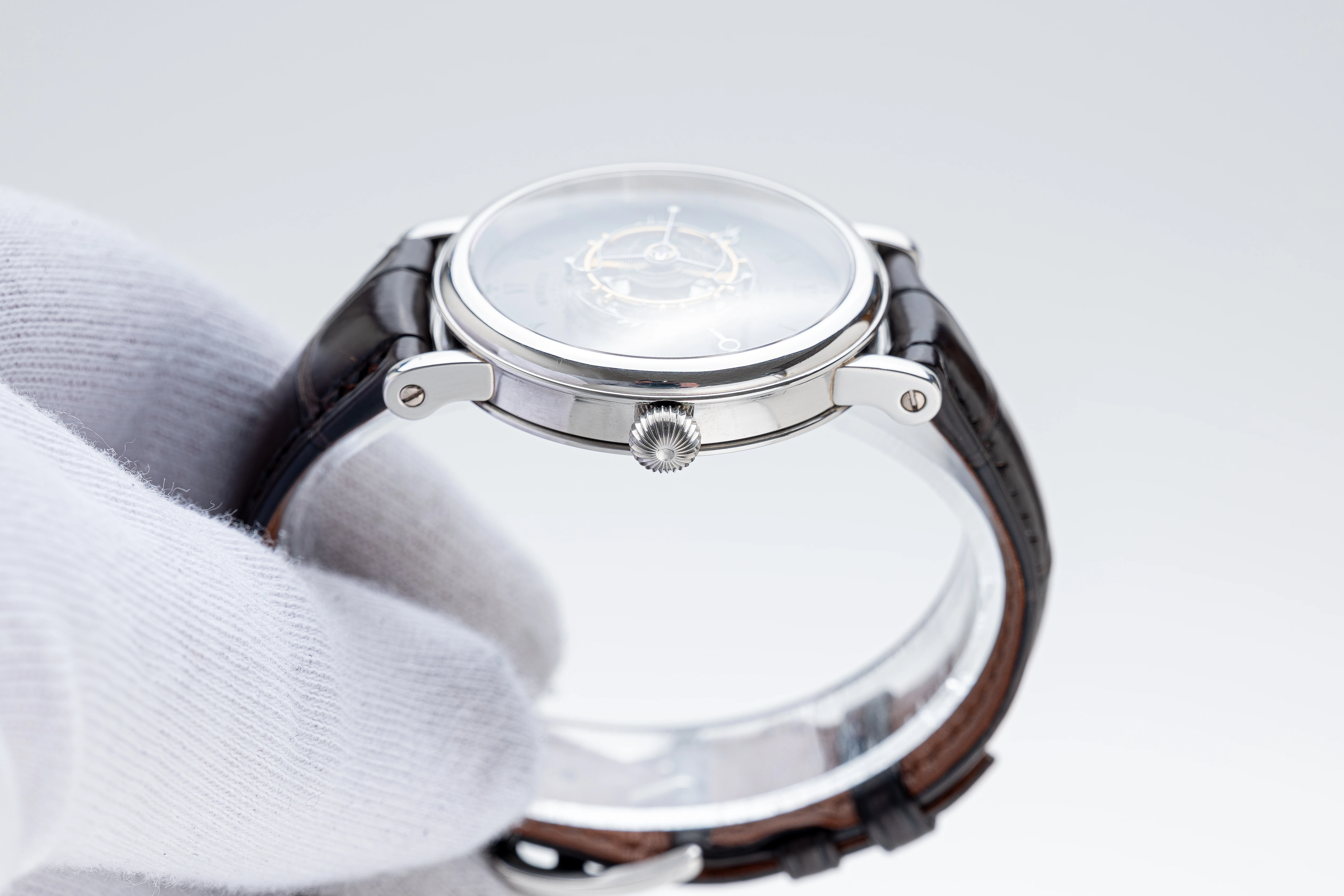
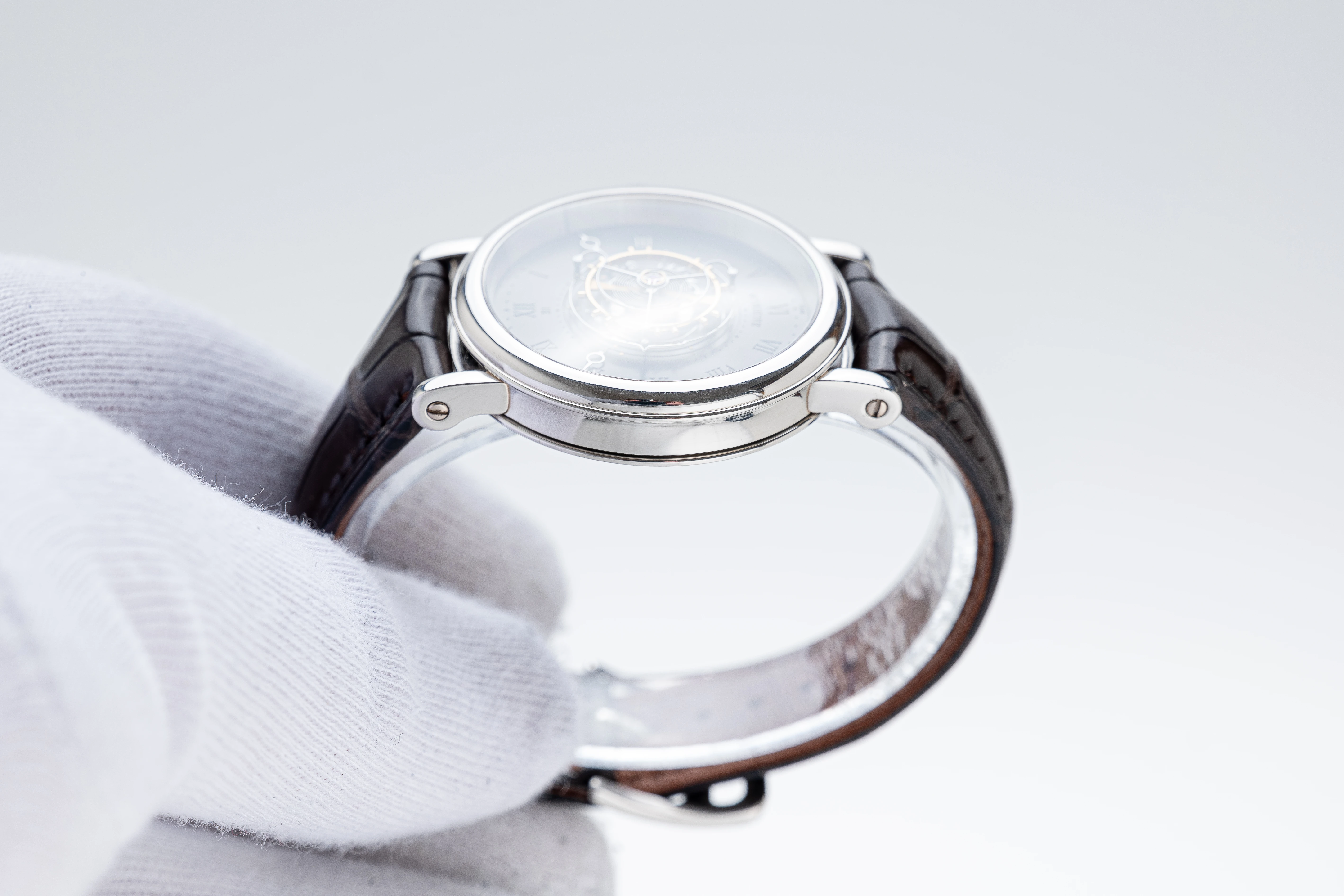
The Haldimann H1 is very comfortable on the wrist, and this is mainly due to its size: with a diameter of 39 mm, the height is only 10 mm - an excellent digits for a complicated watch with a tourbillon that protrudes above the dial. The black dial with its cut-out Roman numerals and minute track clearly plays a secondary role compared to the central flying tourbillon which steals the show, but the dial itself is magnificent. The same goes for the Empire-style case with its straight lugs and the sensual caseband with its highly polished, concave surface.
ABOUT THIS WATCH
Beat Haldimann entered the Olympus of watchmaking in 2002 with the H1 Flying Central Tourbillon, his first wristwatch with a tourbillon. In principle, the appearance of a new tourbillon watch in those years would not have been an outstanding event if there had not been three “buts”. He combined three technical principles in the H1, and did so at an impressively high technical and design level.
Firstly, it was a flying tourbillon. In homage to Alfred Helwig, who had developed his own version of this design for pocket watches in the 1920s, Haldimann created a tourbillon with a “lyra"-shaped carriage, which is very close to Helwig's tourbillon both technically and esthetically.
Secondly, Beat Haldimann made this flying tourbillon impressively large for a wristwatch, almost as large as a tourbillon on a pocket watch with a 16-ligne movement – the tourbillon diameter of the H1 is 17.8 mm.
Finally, and most importantly, Haldimann placed the tourbillon in the center of the dial, forcing him to develop a special drive for the hour and minute hands that surrounds the tourbillon. Although Haldimann was not the first to place a tourbillon in the center of a wristwatch – Omega was the first, with a one-off prototype in 1947 and then, since 1994, with a production model – he did it at a higher level while solving a technical problem that plagued the Omega Central Tourbillon: the need to use two crowns, one to wind and one to set the hands. The H1 Flying Central Tourbillon has a single crown, which has the usual functions.
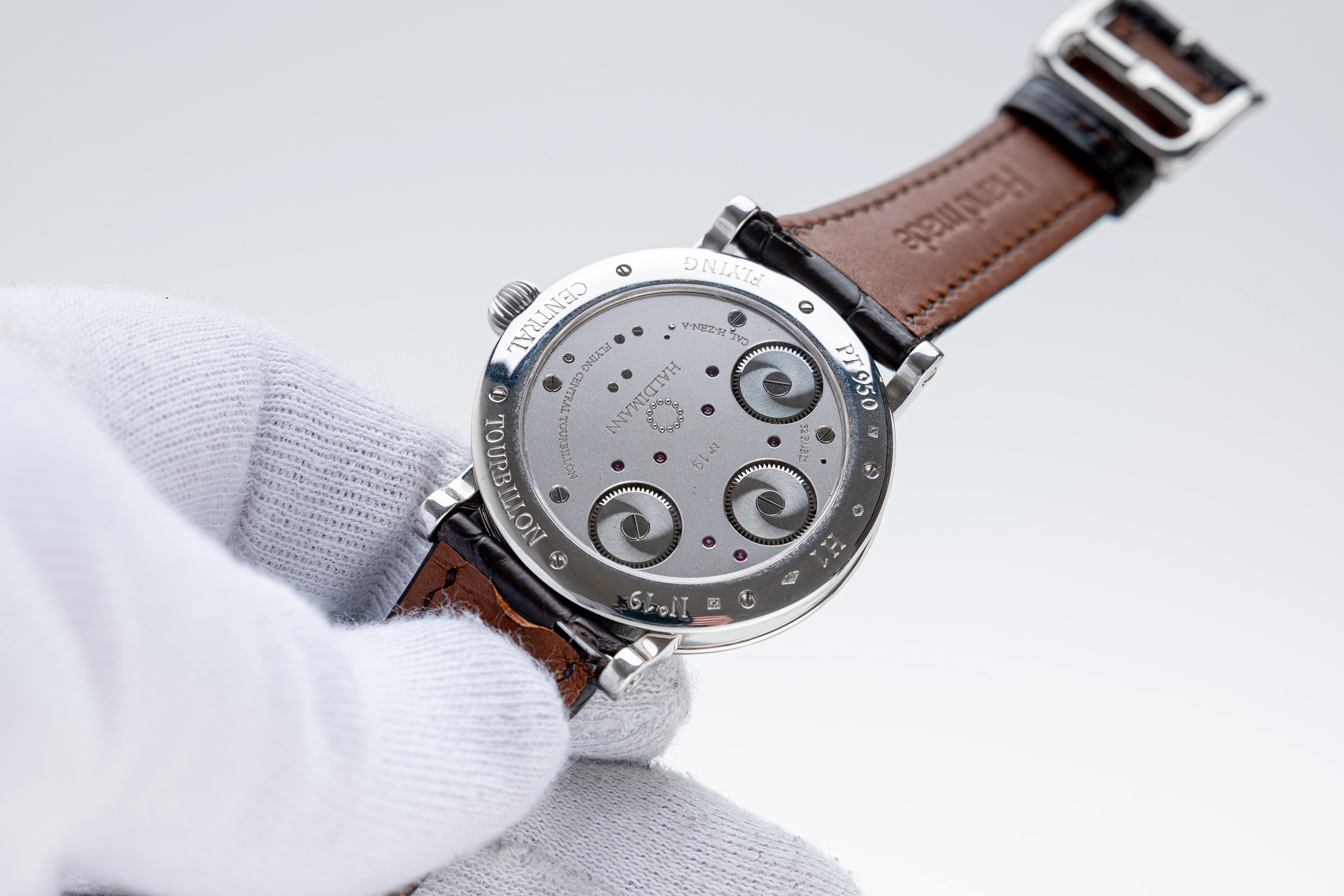
Along the way, Haldimann had to solve other problems, above all the problem of energy. The large tourbillon required a lot of energy, so Haldimann dedicated two of the watch's three barrels to it. This also enabled him to design an elegant system with a symmetrical carriage drive. The third barrel is needed to turn the ring system of the hour and minute hands, which is inevitably massive and therefore energy-intensive. The installation of three barrels results in a very impressive picture, which can be seen on the caseback: Three mainspring barrel wheels with beautiful solarization and beveled teeth are located on a broad mainplate - covering the entire diameter of the movement - with texturing and engraved inscriptions without gilding. This is undoubtedly one of the best examples of Nordic movement design.

ADDITIONAL PHOTOS: