F.P. Journe

Don't hesitate to ask for any additional information, Alex is ready to assist and guide you in your decision
DETAILS
The Tourbillon Souverain à Remontoire d’Egalité will always be of interest, as it marks the very beginning of the F. P. Journe brand’s history. After a series of prototypes and commissioned timepieces produced throughout the 1990s, François-Paul Journe established his brand in 1999 and began developing a collection of watches. This process started with the 1999 release of the Tourbillon Souverain “Souscription” series, which consisted of 20 pieces. It was followed by regular, non-limited models designated as “Reference T,” which remained in production until the end of 2003. These watches were primarily cased in platinum, though some examples were crafted in rose gold. They were powered by caliber 1498, featuring a brass mainplate and bridges, while the dials were fashioned from yellow, rose, or white gold. All Reference T models feature a 38mm case, with the exception of the limited-edition Ruthenium Collection, which has a diameter of 40mm.
Currently, the entire production range of Reference T is generally divided into four generations. The first generation is the Souscription series from 1999, which features only the inscriptions “Invenit et Fecit” and “F. P. Journe” on the dial, along with a remontoire cock that has a rounded, conical top surface. The second-generation watches were also produced in 1999; it is estimated that 17 such pieces were made, featuring platinum cases and dials crafted from either yellow or white gold. On these dials, the additional inscription “Remontoir d’Egalité” appears at 12 o’clock. Starting with watch No. 35, the numbering system shifted from the “No. xx” format to a new “No. xx/yyT” format, where “xx” represents the watch’s serial number, “yy” denotes the year (for example, “99” for 1999, corresponding to the second-generation watches), and the letter “T” (for tourbillon) refers to the specific reference.
Third-generation timepieces, produced between 1999 and 2001, featured a flat remontoire cock. It is believed that the brand made a total of approximately 60 examples in both platinum and rose gold, with the latter being particularly rare. Third-generation models also introduced rose gold dials – only five such examples are known to exist. Depending on the year of production, these third-generation timepieces were numbered xx/99T and xxx/01T (watchesbysjx.com notes that the year 2000 was presumably skipped). The six known examples – numbered 27, 32, 58, 76, 82, and 87 – were fitted with “shiny” rose gold dials, finished with a layer of clear lacquer.
Finally, the fourth generation – to which this watch belongs – was produced from 2001 to 2003. It differs from previous generations by featuring smaller dial screws positioned at 1, 5, and 10 o’clock, as well as bolder printing on the dial. The caseback engraving technique was also updated, resulting in a deeper, more uniform appearance typical of a modern F. P. Journe watch. The method for securing the caseback was further changed: the original slotted screws were replaced with three-notched Holt-head screws. When early examples are returned to F. P. Journe for servicing, the screws are typically replaced with the Holt-head type, which is now standard across all of the brand’s timepieces. In 2003, F. P. Journe introduced the Tourbillon Souverain Ruthenium Collection, a limited edition of 99 pieces featuring a larger 40mm platinum case. Representing the final iteration of the Tourbillon Souverain à Remontoire d’Egalité equipped with a brass movement, these watches bear a serial number format of xx/99-01T.
By April 2004, François-Paul Journe unveiled the Tourbillon Nouveau (Reference TN), powered by the new rose-gold calibre 1403 and featuring deadbeat seconds.
REASONS TO BUY
This Tourbillon Souverain watch – housed in a 38 mm platinum case, numbered 243-03T, and featuring a brass movement with a white gold dial – represents an exceptionally attractive acquisition for collectors and aficionados of F. P. Journe’s horological mastery. It offers a rare chance to own a beautiful and important mechanical timepiece from the early period of this renowned watchmaker’s career.
The watch is remarkable not only for its complex mechanical caliber – developed by Mr. Journe and incorporating a distinctive array of complications – but also for its historical significance, marking the era when F. P. Journe transitioned away from brass movements. Produced in 2003, this piece is clearly among the final examples to feature such a movement.
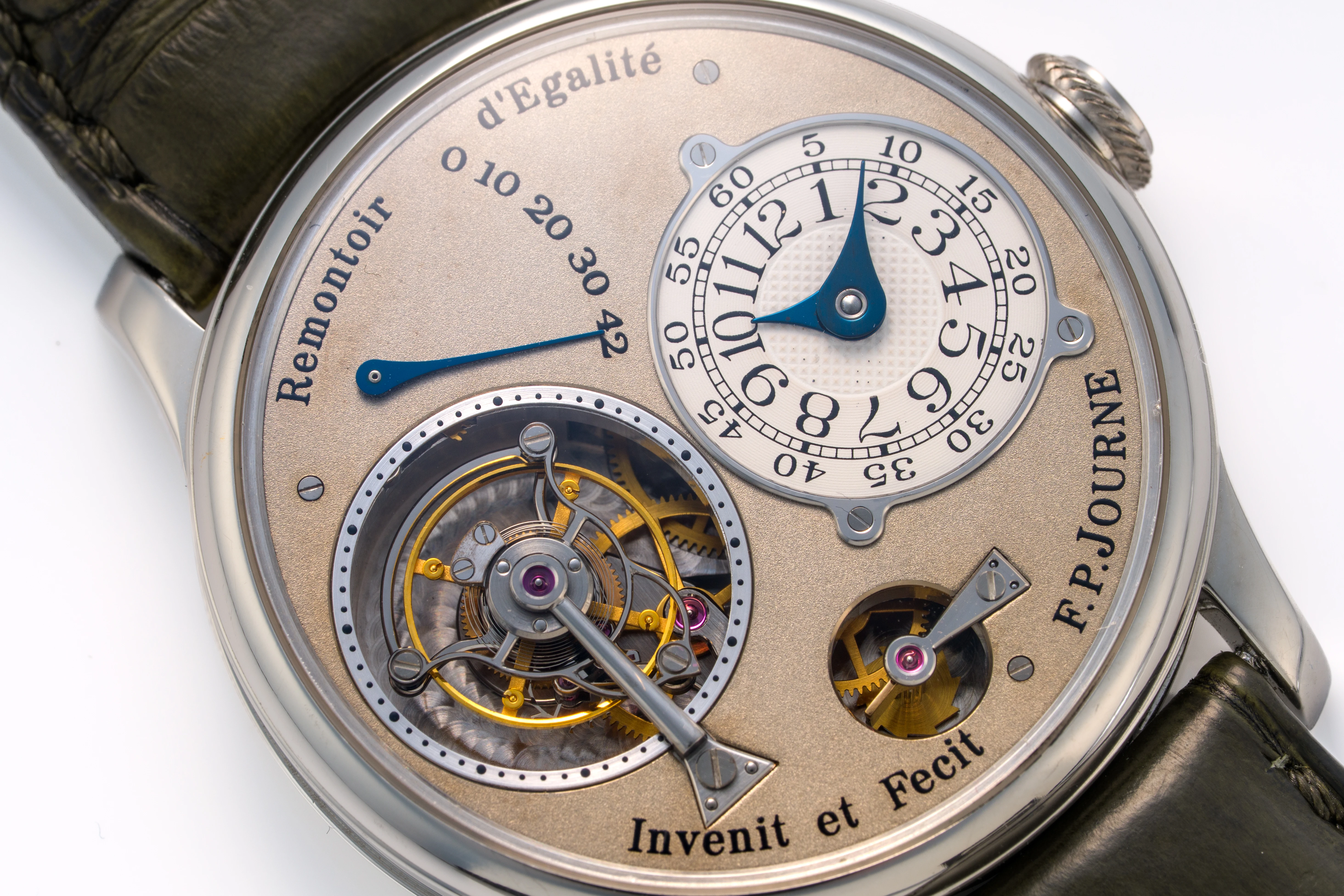
Its superb configuration – comprising a traditionally styled 38 mm platinum case, a frosted solid white gold dial that adds a vintage touch, blued steel hands, and an intricate Ernest Guinand-style tourbillon carriage that imparts a sense of dynamism to the dial, further enhanced by the stop wheel of the constant-force mechanism – undeniably adds to the watch’s immense appeal.
ABOUT THIS WATCH
By 2004, Mr. Journe had completed his production of watches with movements made from brass with galvanic coatings. Since then, almost all new watches from the brand have been equipped with movements mainplate and bridges are made of untreated 18k rose gold. Calibers made of solid gold naturally appear more valuable and impressive, as movements of this type are a great rarity in watchmaking. Nevertheless, collectors and connoisseurs of F. P. Journe’s watchmaking art are showing increasing interest in watches with brass movements, which represent the important early period of the brand. The total number of F. P. Journe watches with brass movements is estimated at about 2,000 pieces.
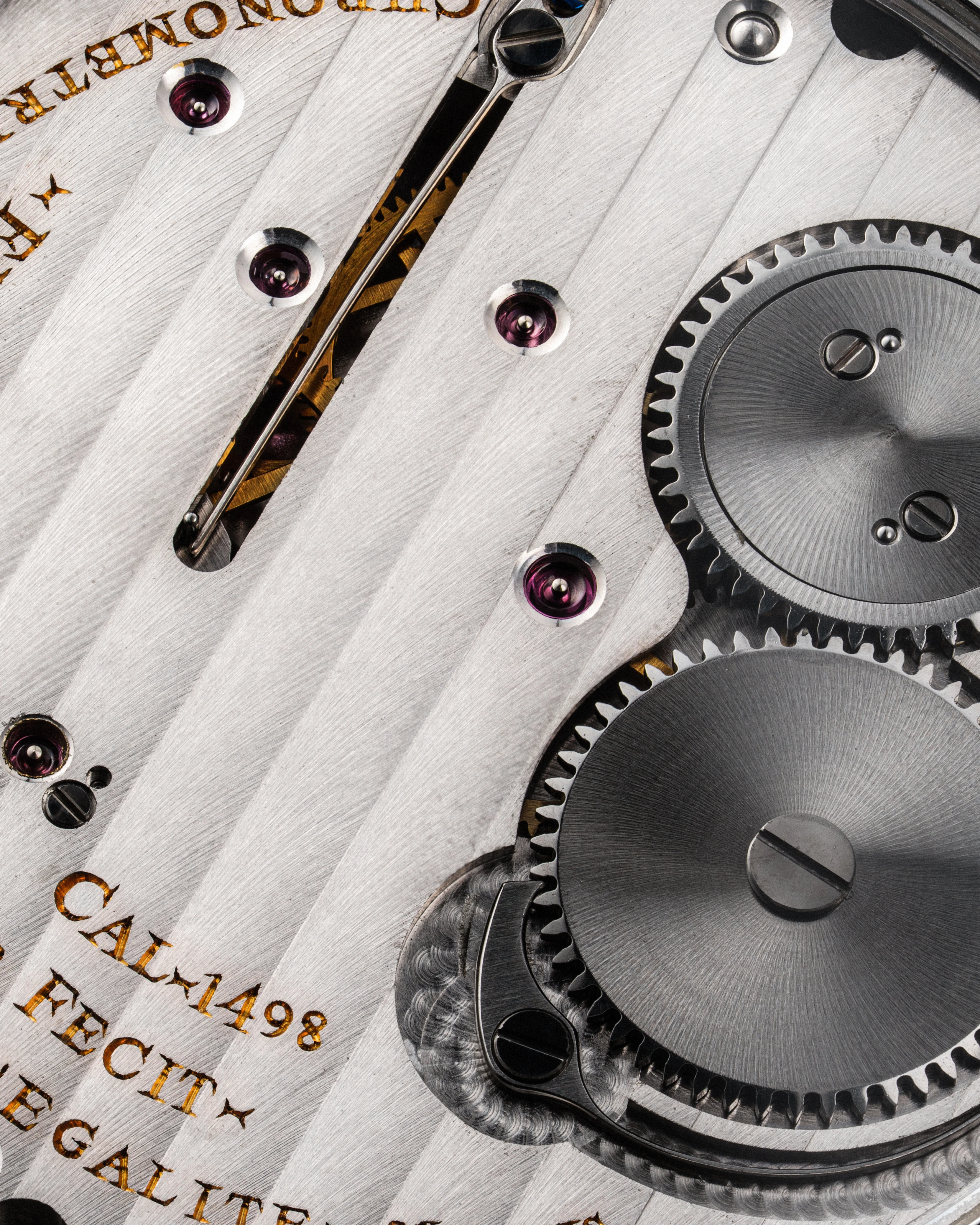
Caliber 1498, used in four generations of Tourbillon Souverain à Remontoire d’Égalité watches, will always be regarded as an impressive achievement from the brand’s early years. It was the first wristwatch movement to combine a tourbillon with a one-second constant-force device (remontoire d’égalité in the watchmaking vocabulary of Mr. Journe). Up to 2003, a total of no fewer than about 410–420 and no more than about 510–520 Tourbillon Souverain watches were produced, including the Tourbillon Souverain Ruthenium Collection, according to the estimate of Osama Sendi, aka The Journe Guy. Only watches equipped with caliber 1498 have a small round aperture at the bottom of the dial with a cantilevered bridge (cock) that holds the axle of the constant-force mechanism’s stop wheel. This wheel makes a jumping turn once a second, while at the same time the flat intermediate spring of the constant-force mechanism is charged, a process visible through the sapphire caseback.
Mr. Journe is known as an outstanding tourbillon master and one of the few watchmakers producing wristwatches that combine a tourbillon with a constant-force complication. This pairing, complemented by a power reserve indicator, is among the most sophisticated found in “simple” tourbillon wristwatches and delivers exceptional accuracy and stability in the watch’s rate. Another notable feature of Journe’s tourbillon watches is the way the power reserve indicator is marked, following the tradition of 19th-century chronometers: the hand shows the time elapsed since the movement was fully wound, so when the watch is fully wound, the hand points to zero.
The Tourbillon Souverain is an indisputable part of the brand’s heritage and a milestone in both watchmaking and design. It has a strong, charismatic style defined by an unconventional dial layout: a tourbillon on the left, a main time sub-dial of similar size with hour and minute hands on the right, a power reserve indicator at the top, and a small aperture at the bottom revealing the stop wheel of a constant-force mechanism. Development of this design began with early wristwatch prototypes incorporating a tourbillon and a constant-force device, produced by Mr. Journe since 1991. In these, he sought to follow in the footsteps of Abraham-Louis Breguet – specifically his montres à souscription, some of which featured a small auxiliary dial mounted directly onto the movement. Over time, the aesthetic of Mr. Journe’s tourbillons evolved, ultimately taking its definitive form in the 1999 Tourbillon Souverain Souscription series. This iteration introduced a two-tone dial structure, a subtle asymmetry created by the power reserve hand, distinctive drop-shaped hands, and typography – including the Arabic numerals – designed by Mr. Journe himself. This signature style has remained largely unchanged across F.P. Journe’s tourbillon wristwatches for many years, right up to the contemporary Nouveau Tourbillon Souverain Vertical.
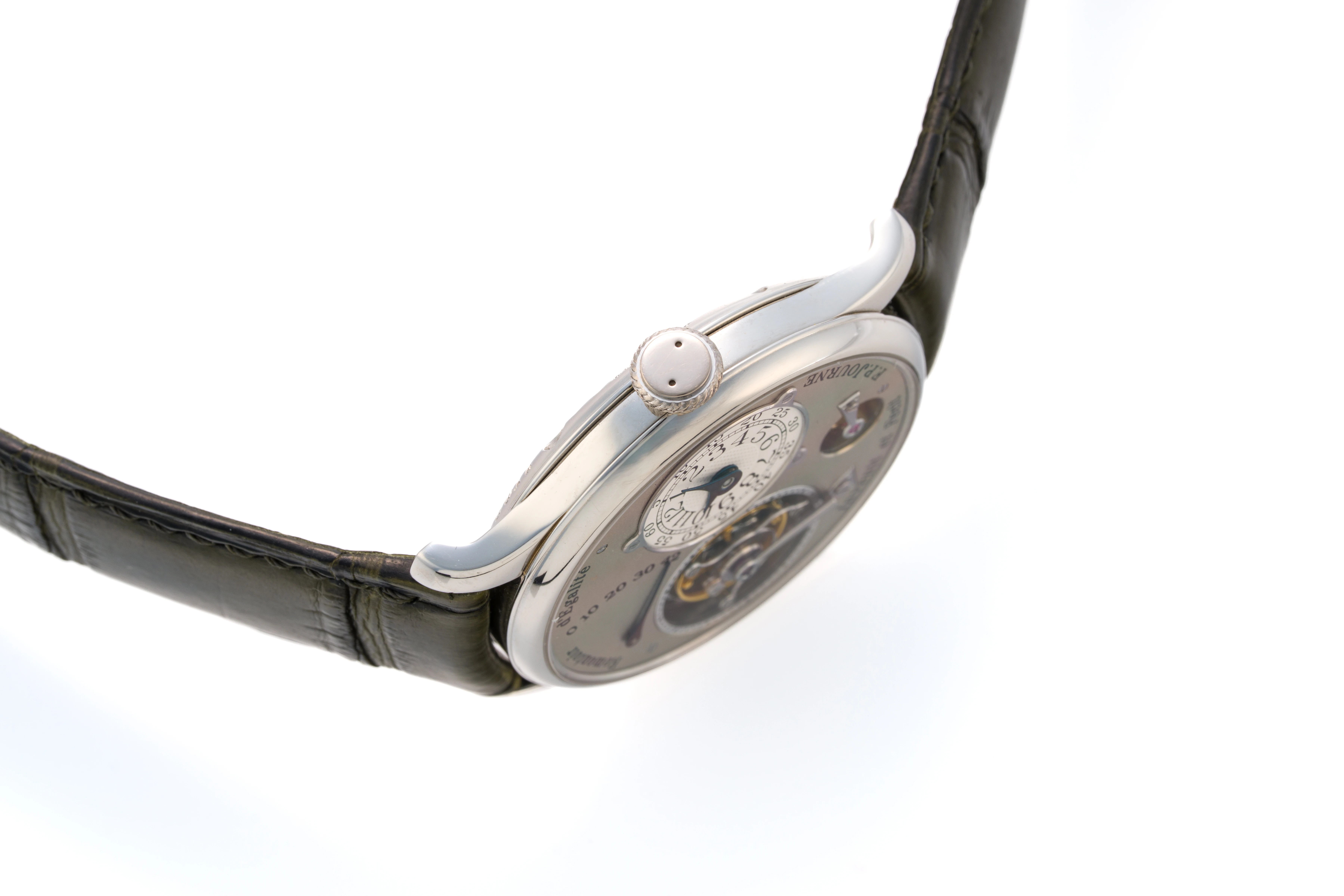
The elegant 38 mm platinum case, impressively slim for such a complex tourbillon and constant-force movement, together with the matching F.P. Journe platinum buckle, significantly enhances the watch’s perceived value and underscores its historical significance as a signature F.P. Journe design, while also ensuring it remains comfortable to wear as an exclusive dress watch.

Specifications
| Ref | T |
| D= | 38 mm |
| Case material | Platinum |
Condition report
| Box: | Yes |
| Papers: | Yes |
ADDITIONAL PHOTOS: